

Anderson Robadel is part of a group of farmers in Caparaó who began exploring specialty coffee thanks to Clayton Barrossa, whose coffees we regularly offer. He was one of the first to collaborate with FAF in applying the principles of ecological farming. Thanks to his success, many others have followed suit.
Anderson manages the farm alongside his wife, Joyce. Both have been involved in the coffee world their entire lives. Anderson began slowly taking over the farm from his father in 1996. However, it wasn't until 2015 that they participated in their first coffee competition, which led them to shift towards specialty coffee and adopt a responsible approach to agriculture.
The coffee they produce is of the catucai variety and processed using the dry method. Due to the high altitude and cool weather, it yields fruitier coffees than what is typical for Brazil.
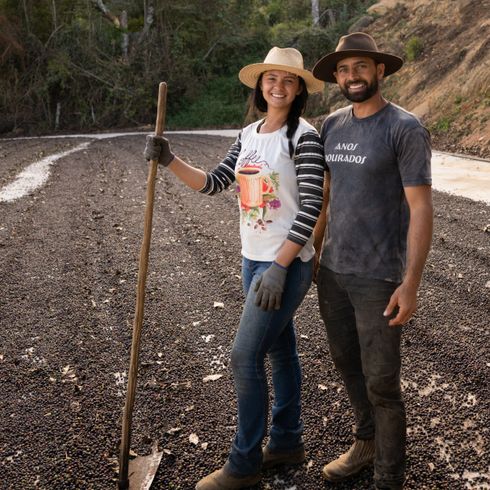
Farm Coffee Family


Unique terroir
The Caparaó region is among the most beautiful national parks in Brazil. It borders the state of Minas Gerais to the west and Espirito Santo to the east. The climate here is entirely different from other places where we source Brazilian coffee. Farms are situated at the foot of the Pico da Bandeira mountain, which, at 2892 meters, is the third highest peak in Brazil. The local climate is the coolest in the entire country, with winter temperatures dropping as low as -10°C. Coffee cultivation is therefore very specific. The harvest is delayed from August to November. The cherries ripen slowly, and drying on African beds is only possible under shelter due to frequent rains and cold nights. This process often takes 20-30 days.